Battery Management System Market Poised for Rapid Growth at 20.1% CAGR
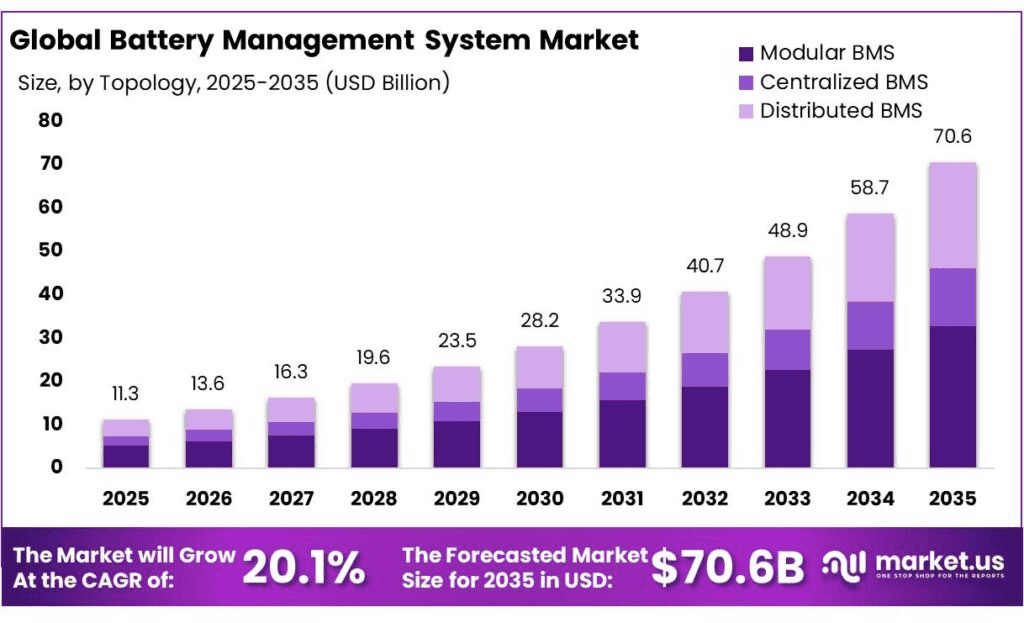
The global Battery Management System (BMS) market is on the cusp of a significant expansion, with a projected Compound Annual Growth Rate (CAGR) of 20.1% from 2026 to 2035. This remarkable growth is driven by the increasing adoption of electric vehicles, energy storage systems, and renewable power applications, which all rely heavily on advanced BMS solutions.
As of 2025, the Global BMS market was valued at USD 11.3 billion, with the Asia Pacific region dominating the market share, accounting for more than 47.1% with revenue of USD 5.3 billion. The rising demand for electric vehicles and energy storage systems is a key factor driving the growth of the BMS market. According to the International Energy Agency (IEA), global electric car sales exceeded 20 million units in 2025, representing nearly one-quarter of new vehicle sales.
The IEA also highlights the need for a significant increase in battery storage capacity to support the transition to renewable energy sources. The agency estimates that battery storage capacity must increase 14 times to around 1,200 GW by 2030 under the Net Zero pathway, requiring annual deployment growth of approximately 25%. This development is increasing the need for advanced BMS solutions to improve battery safety, reliability, and performance.
Declining battery costs, increased use of lithium iron phosphate (LFP) batteries, stricter safety regulations, and renewable energy integration are also supporting market growth. The price of lithium-ion batteries has declined dramatically, from around USD 1,400/kWh in 2010 to below USD 140/kWh in 2023. LFP batteries, in particular, have gained popularity, representing about 40% of EV battery sales and 80% of new battery storage systems in 2023.
Regulatory developments are further creating opportunities for BMS adoption. The European Union Sustainable Batteries Regulation introduces lifecycle, safety, recycling, and sustainability requirements, including lithium recovery targets of 50% by 2027 and 80% by 2031. The IEEE published Std 2686-2024 for stationary energy storage BMS, establishing guidelines for architecture, communication, cybersecurity, safety, and battery longevity.
Modular BMS dominates the Global Battery Management System Market with a 46.5% revenue share. Modular Battery Management Systems hold the leading position due to their scalability, flexibility, and suitability for advanced battery architectures used in electric vehicles and large-scale energy storage systems. These systems allow manufacturers to expand battery capacity by adding modules without requiring complete redesigns, improving integration efficiency and reducing development complexity.
The growing demand for high-capacity battery packs and adaptable energy storage solutions is driving the adoption of modular BMS. As the world transitions to renewable energy sources and electric vehicles, the need for advanced BMS solutions will continue to grow. The global BMS market is expected to reach approximately USD 70.6 billion by 2035, presenting significant opportunities for manufacturers, suppliers, and investors in the industry.
Summary Points
The global BMS market is projected to grow at a CAGR of 20.1% from 2026 to 2035
The Asia Pacific region dominated the market share in 2025, accounting for more than 47.1% with revenue of USD 5.3 billion
The rising adoption of electric vehicles and energy storage systems is driving the growth of the BMS market
Declining battery costs, increased use of LFP batteries, and stricter safety regulations are supporting market growth
The global BMS market is expected to reach approximately USD 70.6 billion by 2035
