Maruti Suzuki Accelerates Sustainability Drive with Biogas Capacity Expansion
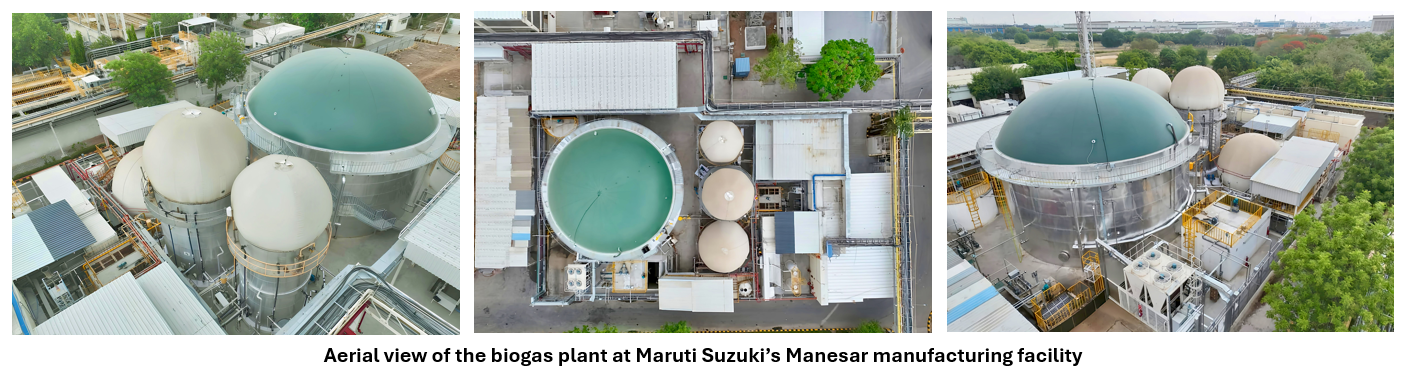
Indian automotive giant Maruti Suzuki has announced an ambitious plan to reduce its fossil fuel dependence by ramping up its biogas capacity through two new projects. The company will commission a 10 tonnes per day (TPD) biogas plant at its Kharkhoda facility within the current financial year (FY 2026-27), while also completing an expansion of its existing plant at Manesar — increasing output there from 0.2 TPD to 0.7 TPD.
The Kharkhoda plant is expected to meet approximately 20% of the facility's total gas requirement and mitigate an estimated 9,490 tonnes of CO₂ annually. The expanded Manesar plant, which came online earlier this month, will generate around 3.6 lakh standard cubic metres of biogas per year, avoiding an estimated 664 tonnes of CO₂ emissions. This move is a significant step towards reducing the company's carbon footprint and dependence on fossil fuels.
The Manesar facility uses food waste, Napier grass, and paddy straw as feedstock — with provision to supplement output using cattle dung — and employs anaerobic digestion technology to convert agricultural waste into raw biogas. The gas feeds into paint shop heating and canteen operations, while fermented organic manure (FOM) produced as a by-product is used for horticulture or returned to the agricultural supply chain. This closed-loop system showcases the company's commitment to sustainability and reducing waste.
Maruti Suzuki has earmarked INR 150 crore for the two projects and plans to invest INR 925 crore in green energy initiatives overall by FY 2030-31. The company's installed solar capacity currently stands at 79 MWp, with a target of 319 MWp by the same date. This significant investment in renewable energy is a testament to the company's dedication to reducing its environmental impact and promoting sustainable practices.
The announcements were made on World Environment Day (5 June), highlighting the company's commitment to reducing fossil fuel consumption and oil import dependence at a time of global energy uncertainty. Managing Director and CEO Hisashi Takeuchi stated that the projects reflect the company's commitment to sustainability and reducing its carbon footprint. Maruti Suzuki recently replaced natural gas with biogas to cover around 10% of energy requirements at its Hansalpur facility, following LNG supply constraints.
This move is part of a larger trend in the automotive industry, where companies are increasingly shifting towards sustainable and renewable energy sources. The use of biogas, in particular, offers a promising solution for reducing greenhouse gas emissions and dependence on fossil fuels. As the world grapples with the challenges of climate change, companies like Maruti Suzuki are leading the way in adopting innovative and sustainable solutions.
In a similar vein, other companies are also investing in biogas and renewable energy projects. For instance, Vanguard Renewables has broken ground on a new anaerobic digestion facility in Litchfield, Minnesota, developed in partnership with TotalEnergies and co-located at Wagner Dairy, a family farm operating since 1887. The plant will process more than 300 tonnes of food and beverage waste per day, converting it into renewable natural gas (RNG) and nutrient-rich fertiliser.
As the world transitions towards a more sustainable and renewable energy-based economy, companies like Maruti Suzuki are at the forefront of this change. Their commitment to reducing their carbon footprint, investing in renewable energy, and promoting sustainable practices sets a positive example for other companies to follow. With the Indian government's push for renewable energy and sustainability, Maruti Suzuki's initiatives are well-timed and poised to make a significant impact on the company's and the country's sustainability goals.
In conclusion, Maruti Suzuki's biogas capacity expansion is a significant step towards reducing the company's dependence on fossil fuels and promoting sustainability. With a strong commitment to renewable energy and sustainable practices, the company is leading the way in the automotive industry and setting a positive example for other companies to follow. As the world continues to grapple with the challenges of climate change, companies like Maruti Suzuki are at the forefront of the transition towards a more sustainable and renewable energy-based economy.
Summary Points
Maruti Suzuki is expanding its biogas capacity through two new projects, including a 10 TPD biogas plant at its Kharkhoda facility and an expansion of its existing plant at Manesar.
The company aims to reduce its fossil fuel dependence and promote sustainability through its green energy initiatives, with a target of 319 MWp of installed solar capacity by FY 2030-31.
The biogas plants will use food waste, Napier grass, and paddy straw as feedstock, with anaerobic digestion technology converting agricultural waste into raw biogas.
Maruti Suzuki has earmarked INR 150 crore for the two projects and plans to invest INR 925 crore in green energy initiatives overall by FY 2030-31.
The company's commitment to sustainability and renewable energy is part of a larger trend in the automotive industry, where companies are increasingly shifting towards sustainable and renewable energy sources.