Global Wind Energy Sector Achieves Record-Breaking 165 GW Installations in 2025
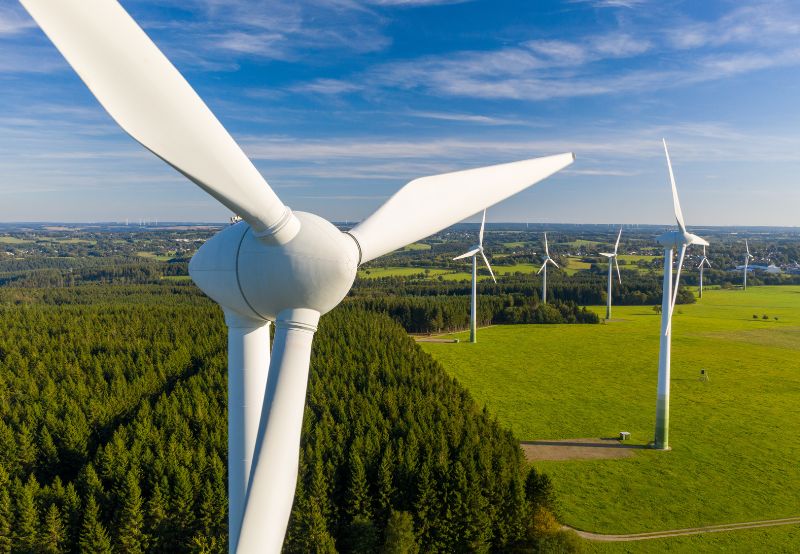
The global wind energy sector has marked a significant milestone, achieving a record 165 GW of new grid-connected capacity installed in 2025. This represents a 40% year-on-year increase, taking the total installed capacity worldwide to 1,299 GW, according to the Global Wind Energy Council (GWEC). This unprecedented growth underscores the sector's potential to play a vital role in the global transition to renewable energy.
The impressive growth was driven primarily by the Asia Pacific region, which accounted for nearly 80% of global installations in 2025. China and India were the leading contributors, collectively adding over 126 GW of new capacity. The Global Wind Report 2026 by GWEC highlights that offshore wind contributed 9 GW, marking an 18% increase from 2024 and the third-highest annual total to date. This expansion is a clear indication of the industry's ability to scale up and meet the rising demand for clean energy.
The market is projected to maintain a steady compounded annual growth rate of 5.2% from 2026 to 2030, with annual installations expected to reach 178 GW in 2026. Over the next five years, total additions are anticipated to reach 969 GW, averaging 194 GW annually. This growth trajectory is being driven by factors such as rising electricity demand, energy security concerns, and policy-driven expansion of renewable capacity across major economies. As the world grapples with the challenges of climate change, the wind energy sector is poised to play an increasingly important role in reducing carbon emissions and promoting sustainable development.
The Asia Pacific region's dominance in the global wind energy market is expected to continue, with China and India leading the charge. In 2025, India added 6.3 GW of wind power capacity, representing an 85.2% year-on-year increase from 3.4 GW in 2024. This significant growth underscores India's commitment to renewable energy and its potential to emerge as a major player in the global wind energy market. Europe also recorded notable growth, with 19.1 GW of new installations, a 16% annual increase, and cumulative capacity surpassing 300 GW.
Meanwhile, the North American market maintained its position as the third-largest market, driven by a 71% year-on-year increase in installations in the United States. Latin America, however, witnessed a 24% decline, primarily due to a slowdown in Brazil, where installations dropped by one-third to around 2.3 GW. Africa and the Middle East, on the other hand, saw a 32% growth, supported by a recovery in South Africa and expansion in Saudi Arabia.
The concentration of the market remains high, with China, the U.S., India, Germany, and Brazil accounting for 86% of global additions and around 75% of total installed capacity. China alone contributed 73% of global onshore installations, highlighting its dominance in the sector. Emerging markets, however, are becoming increasingly important to the global wind landscape, with Southeast Asia offering significant potential for growth. The region has set ambitious targets to achieve a 32% share of renewables by 2030 and 52% by 2040.
In Africa, countries like Kenya and Egypt are making significant strides in the adoption of renewable energy. Kenya aims to achieve 100% renewable electricity by 2030, while Egypt's Zaafarana wind project has a capacity of 545 MW, with plans for a 5.2 GW hybrid expansion. In Latin America, Chile's wind capacity has reached around 6 GW, with 1.2 GW added in 2025, representing 24% growth. These developments underscore the growing importance of emerging markets in the global wind energy sector and the potential for renewable energy to drive economic growth and sustainable development.
Summary Points
The global wind energy sector achieved a record 165 GW of new grid-connected capacity installed in 2025, representing a 40% year-on-year increase.
The Asia Pacific region accounted for nearly 80% of global installations in 2025, with China and India collectively adding over 126 GW of new capacity.
The market is projected to maintain a steady compounded annual growth rate of 5.2% from 2026 to 2030, with annual installations expected to reach 178 GW in 2026.
Emerging markets, such as Southeast Asia, Africa, and Latin America, are becoming increasingly important to the global wind landscape, with significant potential for growth and development.
The concentration of the market remains high, with China, the U.S., India, Germany, and Brazil accounting for 86% of global additions and around 75% of total installed capacity.