Debunking the Viral Video: Indonesian Waters Not Polluted by Ship Dumping Trash
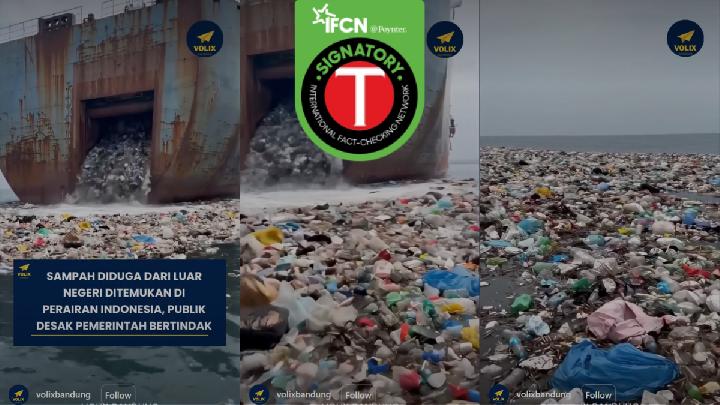
A disturbing video has been making the rounds on social media, purporting to show a ship dumping a massive pile of trash into Indonesian waters. The content has sparked outrage and concern among the general public, with many calling for the government to take immediate action. However, a thorough investigation by Tempo has revealed that the video is, in fact, a product of AI-generated imagery.
The video includes a narration that expresses public concern over the discovery of trash suspected to have originated from abroad. The caption accompanying the post reads, “The discovery of trash suspected to have originated from abroad in Indonesian waters has sparked public concern. The origin of the trash is still under investigation, while calls are mounting for the government to thoroughly investigate the matter and tighten maritime surveillance to protect the environment and national sovereignty.”
However, Tempo’s visual analysis has revealed inconsistencies in the dumped trash. The majority of the trash was gray, which is in contrast to the colorful nature of typical marine debris. The objects also appeared static despite being battered by waves, as if they were stuck together and rigidly attached to the sea surface. This analysis suggests that the video is not a genuine representation of the situation.
A review of conversations on the X platform regarding the video revealed that several netizens shared screenshots of when the video was first uploaded to the social media platform. The caption “made with AI” was visible in the initial version, indicating that the video was created using AI. The video was first shared by a Kannada-language account on X on February 23, 2026.
The Hive Moderation tool confirmed that the AI-generated content in the 12-second video accounted for 99.9 percent of the video. The AI or Not tool also detected 71 percent of the content as AI-generated, likely using the Suno audio model. These findings further support the conclusion that the video is a product of AI-generated imagery.
Meanwhile, Indonesia faces a significant marine debris problem. According to data from the National Waste Management Information System (SIPSN) 2025, national waste generation reaches 50 million tons per year. Nearly half of this, approximately 20 million tons, ends up in the ocean via river flows, coastal areas, and port activities. This pollution not only damages the environment’s aesthetics but also drives away fish populations.
In response to this situation, the Ministry of Marine Affairs and Fisheries (KKP) has launched the Clean, Healthy, and Waste-Free Seas (Laut Sebasah) program. Partnering with the private sector and NGOs, the government aims to reduce marine waste by 40 percent by 2027 and 70 percent by 2029. However, Ecoton Executive Director Daru Setyorini believes that the government’s efforts have yet to yield significant results.
Setyorini argues that current initiatives remain insufficiently systematic and large-scale. The prevailing approach has tended to view plastic pollution solely as a waste management issue, rather than a complex problem that requires a comprehensive solution. To effectively address the issue, the government must adopt a more holistic approach that involves all stakeholders, including the private sector, NGOs, and local communities.
Summary Points
The viral video showing a ship dumping trash into Indonesian waters is a product of AI-generated imagery
Indonesia faces a significant marine debris problem, with 50 million tons of waste generated annually
The government has launched the Clean, Healthy, and Waste-Free Seas (Laut Sebasah) program to reduce marine waste
Current initiatives to address marine pollution remain insufficiently systematic and large-scale
A comprehensive solution to the problem requires a holistic approach that involves all stakeholders