Mount Merapi Unleashes Fury: Understanding the Volcano's Latest Eruptions and Alert Status
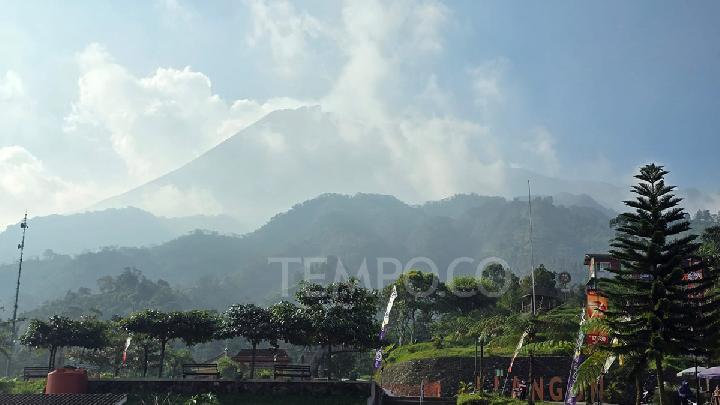
Mount Merapi, one of Indonesia's most active and volatile volcanoes, has been making headlines with its recent bout of intense eruptions. According to the Geological Disaster Technology Research and Development Center (BPPTKG), the volcano released at least three hot clouds during the week of May 8 to 14, 2026, with the eruptive activity directed towards the upstream of Kali Krasak and a maximum sliding distance of 2,000 meters.
The Head of BPPTKG, Agus Budi Santoso, emphasized that the volcano's status remains at the Alert level III due to the continuous magma supply from the mountain's interior. This ongoing activity has led to significant changes in the thermal and morphological conditions of Mount Merapi's lava dome, with monitoring data indicating that the magma supply is still ongoing and can trigger the occurrence of hot cloud avalanches in the potential hazard area.
A drone aerial survey conducted on May 7 revealed increased concentrated heat activity in the southwest lava dome sector, with a temperature of 243 degrees Celsius, marking an increase of 24.4 degrees Celsius compared to the previous period's measurement. In contrast, the temperature in the central dome decreased by 4.9 degrees Celsius, reaching 213.7 degrees Celsius.
The changes in the lava dome are closely related to the high potential for eruptive activity, and the ongoing avalanche activities have resulted in a decrease in the volume of the southwest dome by approximately 10,800 cubic meters. Meanwhile, the central Merapi dome remains stable, maintaining a consistent volume of 2,368,800 cubic meters.
Dozens of lava avalanches from unstable dome materials have been observed flowing into various river streams, with the most intense avalanches occurring upstream of the Kali Krasak river. Seismic networks have recorded three instances of hot cloud avalanche earthquakes, alongside other seismic activity, including 43 shallow volcanic earthquakes and 768 avalanche earthquakes.
Given the volcano's ongoing activity, residents living around the slopes of Merapi are advised to exercise extra caution, especially during extreme weather conditions. BPPTKG has instructed that there should be no human activity in any form in areas designated as potential hazard zones to avoid the risk of casualties.
Mount Merapi's history of eruptions dates back to 1548, with the most recent major eruption occurring in 2010, which claimed 273 lives. The volcano's eruptions have been closely monitored by the BPPTKG, which provides critical updates and warnings to the public.
In the context of volcanic activity, understanding the warning signs and alerts is crucial for mitigating the risks associated with eruptions. The Alert level III status indicates that the volcano is experiencing increased unrest, with a higher likelihood of eruptions. The BPPTKG's monitoring efforts play a vital role in providing timely warnings and updates to the public, enabling them to take necessary precautions and stay safe.
As the situation continues to unfold, Boyfriend TV will provide updates and insights into the developments surrounding Mount Merapi's eruptions. Stay tuned for the latest news and updates on this evolving story.
Summary Points
Mount Merapi released at least three hot clouds during the week of May 8 to 14, 2026, with the eruptive activity directed towards the upstream of Kali Krasak.
The volcano's status remains at the Alert level III due to the continuous magma supply from the mountain's interior.
Monitoring data indicates that the magma supply is still ongoing and can trigger the occurrence of hot cloud avalanches in the potential hazard area.
The changes in the lava dome are closely related to the high potential for eruptive activity, with the ongoing avalanche activities resulting in a decrease in the volume of the southwest dome.
Residents living around the slopes of Merapi are advised to exercise extra caution, especially during extreme weather conditions, and avoid areas designated as potential hazard zones.