Unveiling the Ancient Star Factory: NGC 6951 in the Constellation Cepheus
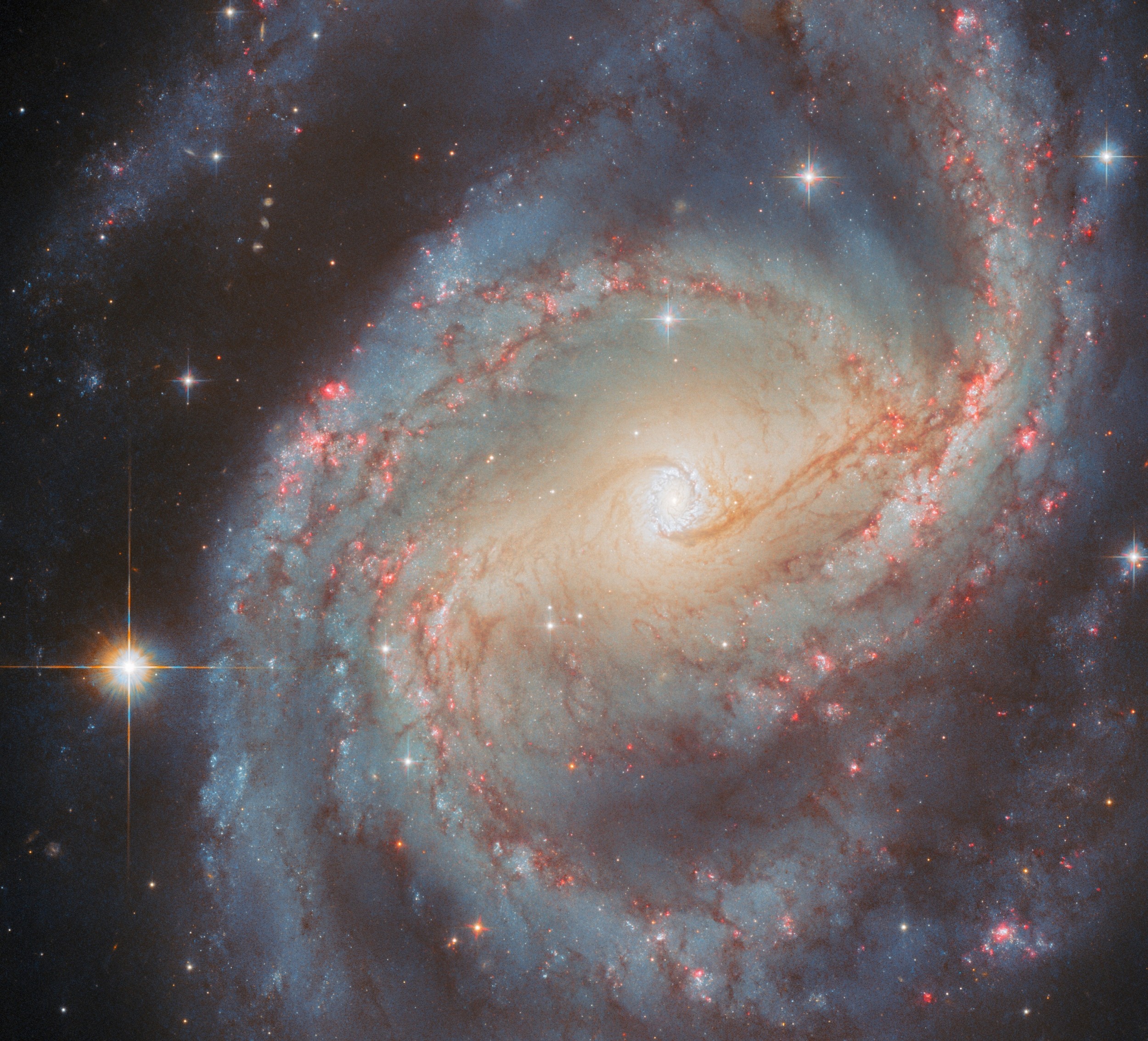
A billion-year-old star factory, nestled in the constellation Cepheus, has been captivating astronomers with its breathtaking beauty and fascinating story of star birth and evolution. The European Space Agency's recent Image of the Day features the spiral galaxy NGC 6951, located approximately 70 million light-years away from Earth. This extraordinary galaxy offers a unique glimpse into the mysteries of the cosmos, with its sweeping arms, radiant core, and a striking white-blue ring surrounding its center.
NGC 6951 is a quintessential spiral galaxy, boasting wide arms that stretch out in sweeping curves, dotted with red nebulae, young blue stars, and thin ribbons of dust. These vibrant regions reveal the formation of new generations of stars, while older stars cluster toward the middle, creating a stunning visual representation of the galaxy's evolution. At the core, a warm, golden glow emanates from ancient suns that have burned steadily for billions of years, adding to the galaxy's mystique.
A distinctive bar of stars runs across the central region, giving the galaxy its stretched appearance. This bar rotates slowly, acting as a conveyor belt, channeling gas from the outer spiral arms toward the galaxy's core. Many spiral galaxies, including our own Milky Way, possess similar bars, which astronomers believe play a vital role in feeding central star-forming regions and even supermassive black holes that anchor galactic centers. The bar's presence has significant implications for our understanding of galactic evolution and the mechanisms that drive star formation.
What sets NGC 6951 apart is the striking circumnuclear starburst ring, a circular zone of intense star formation that encircles the nucleus like a glittering cosmic halo. This ring is a result of the galaxy's bar channeling cold gas into the core, where it accumulates in a dense band approximately 3,800 light-years across. Two dark lanes of dust stretch along the bar, marking the entry points where gas flows inward, creating a fertile ground for stellar nurseries. Dense molecular clouds collapse under their own gravity, igniting bursts of light that can be seen across millions of light-years, making this galaxy a remarkable example of a long-lasting star factory.
Using data from the NASA/ESA Hubble Space Telescope, astronomers have identified over 80 potential star clusters within the ring, many of which are relatively young, forming less than 100 million years ago. However, the ring itself is ancient, with estimates suggesting it may have persisted for as long as 1 to 1.5 billion years, steadily creating stars generation after generation. This remarkable stability demonstrates how some galactic environments can maintain a consistent rhythm, shaping the evolution of the galaxy around it. The energy from these young stars can sculpt the surrounding gas, spark further formation, and contribute to the complex web of feedback that regulates a galaxy's life cycle.
NGC 6951 has been a frequent target for Hubble observations, not only for its beauty but also for its potential to reveal insights into galactic physics. Researchers have used it to map how dust behaves in nearby galaxies and to study how gas moves within rotating disks. The galaxy serves as a natural laboratory for understanding the link between large-scale structures, like bars and spiral arms, and the compact, energetic centers of galaxies. Over the years, astronomers have also monitored NGC 6951 for stellar explosions, with at least five or six supernovae observed, each marking the violent death of a massive star and leaving behind remnants that seed space with heavy elements.
The study of NGC 6951 has far-reaching implications for our understanding of the universe, from the formation of stars and galaxies to the complex interplay between matter and energy. As we continue to explore the cosmos, galaxies like NGC 6951 serve as vital reminders of the beauty, complexity, and mystery that surround us. By unraveling the secrets of this ancient star factory, astronomers can gain a deeper understanding of the fundamental laws that govern the universe, ultimately shedding light on the very nature of existence itself.
Summary Points
The spiral galaxy NGC 6951, located 70 million light-years away, is a billion-year-old star factory with a unique structure and composition.
The galaxy's bar plays a crucial role in channeling gas toward the core, fueling star formation and potentially feeding a supermassive black hole.
The circumnuclear starburst ring is a striking feature of NGC 6951, with over 80 potential star clusters identified within the ring.
The galaxy's stability and long-lasting star formation are remarkable, with the ring potentially persisting for 1 to 1.5 billion years.
The study of NGC 6951 has significant implications for our understanding of galactic evolution, star formation, and the complex interplay between matter and energy in the universe.
