Groundbreaking Discovery: Scientists May Have Finally Cracked the Black Hole Information Paradox
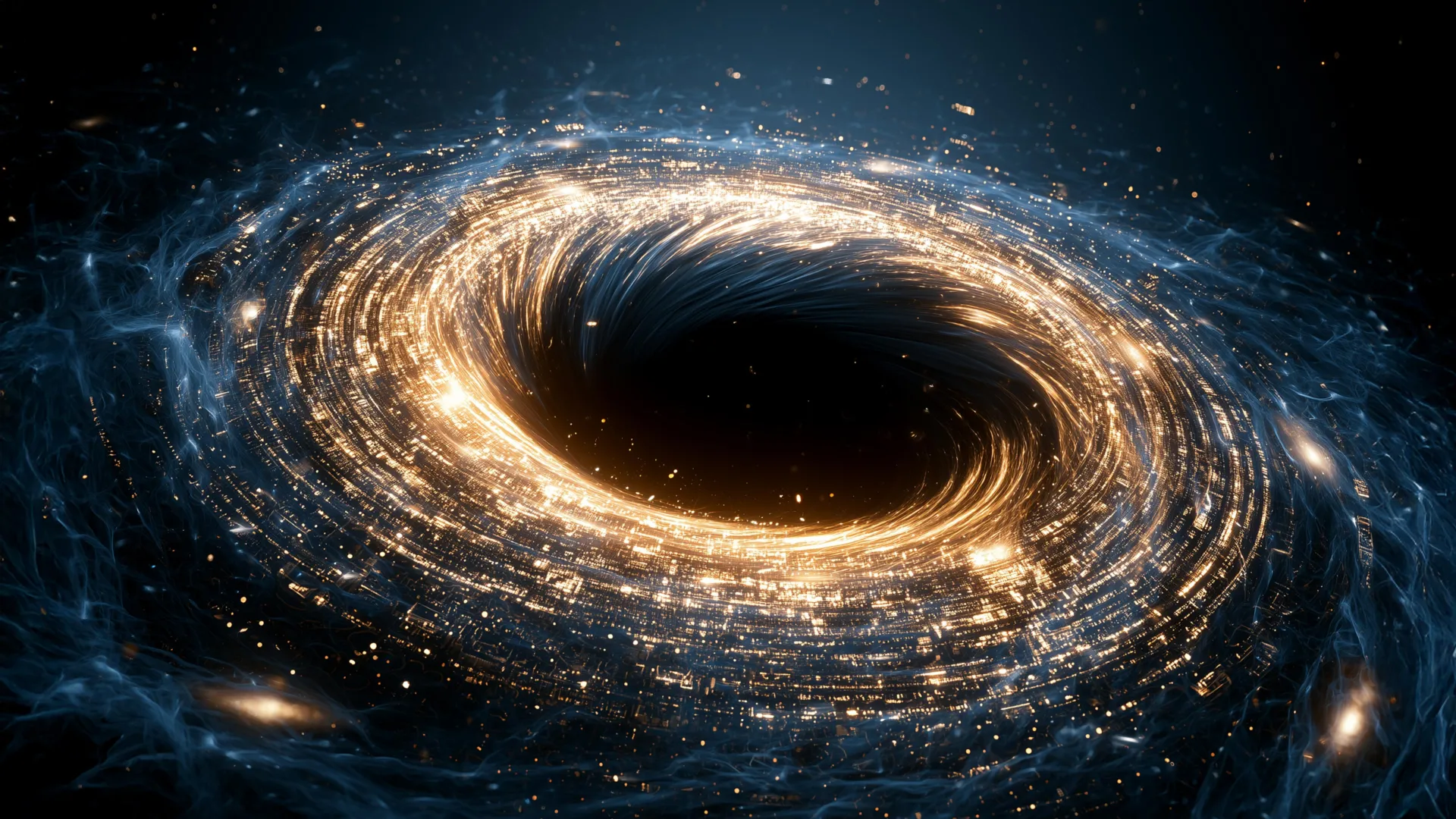
A long-standing puzzle in modern physics, the black hole information paradox, has been a subject of intense debate among scientists for decades. The paradox, first proposed by Stephen Hawking in the 1970s, questions what happens to the information contained in matter that falls into a black hole. Hawking's semi-classical calculations showed that black holes emit a faint form of radiation, now known as Hawking radiation, which slowly drains their energy, causing them to shrink and eventually disappear. However, this creates a problem, as the principles of quantum mechanics dictate that information cannot be destroyed.
A new study, led by Richard Pinčák and published in General Relativity and Gravitation, proposes a possible solution to this paradox. The researchers suggest that the answer may lie in the geometry of a higher-dimensional universe, specifically in the Einstein-Cartan theory, which describes gravity in 7 dimensions on a mathematical structure called a G2-manifold with torsion. Unlike Einstein's General Relativity, which describes spacetime as something that can bend or curve, Einstein-Cartan theory also allows spacetime to twist, generating a repulsive force that works against gravitational collapse.
The team's calculations show that this repulsive effect can stop the final stage of Hawking evaporation, leaving behind a stable remnant with a predicted mass of about 9*10-41 kg. This remnant, the researchers propose, serves as a long-term information repository, storing information through a spectrum of quasi-normal modes associated with its structure. The study suggests that a remnant left behind by a black hole with the mass of the Sun could store approximately 1.515*1077 qubits of information, which is exactly sufficient to preserve the information needed to resolve the paradox.
The implications of this study extend beyond black holes and into particle physics. The researchers argue that reducing the geometry from 7 dimensions to 4 dimensions, the spacetime we experience, naturally produces the electroweak scale, which is closely associated with the Higgs field, responsible for giving elementary particles their mass. The study provides a geometric explanation for the mass hierarchy problem, one of the long-standing challenges in particle physics.
While the idea of extra dimensions may seem like the stuff of science fiction, it is a well-established concept in theoretical physics. The Kaluza-Klein theory, proposed in the 1920s, suggests that our universe has more than the four dimensions we experience. However, the particles linked to these dimensions, known as Kaluza-Klein excitations, would have masses beyond what current particle accelerators can reach. The study emphasizes that being beyond the reach of current technology does not mean that the idea is unfounded, but rather that it requires further exploration and experimentation.
The discovery has significant implications for our understanding of the universe, black holes, and the behavior of matter at the quantum level. As scientists continue to explore the mysteries of the universe, this study provides a crucial step forward in resolving one of the most enduring paradoxes in modern physics. The solution to the black hole information paradox may have far-reaching consequences, from our understanding of the behavior of black holes to the origins of the mass of fundamental particles.
Summary Points
The black hole information paradox, proposed by Stephen Hawking, questions what happens to the information contained in matter that falls into a black hole.
A new study suggests that the answer may lie in the geometry of a higher-dimensional universe, specifically in the Einstein-Cartan theory.
The researchers propose that the remnant left behind by a black hole serves as a long-term information repository, storing information through a spectrum of quasi-normal modes associated with its structure.
The study provides a geometric explanation for the mass hierarchy problem, one of the long-standing challenges in particle physics.
The discovery has significant implications for our understanding of the universe, black holes, and the behavior of matter at the quantum level.
