Mount Semeru Erupts Again: Indonesia's Volcanic Hotspot Unleashes Fury
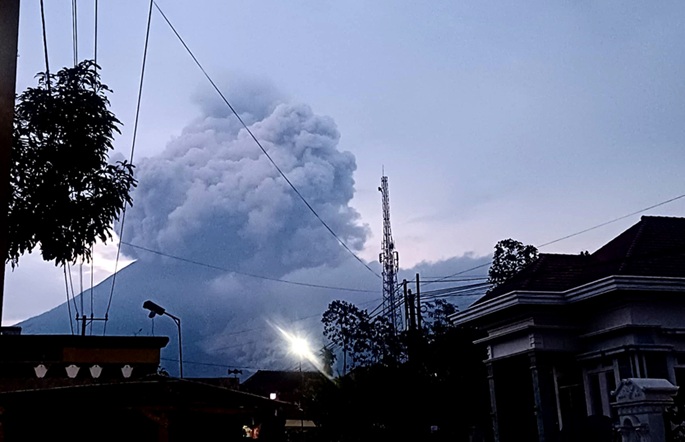
Mount Semeru, Indonesia's highest peak and one of its most active volcanoes, has erupted again, spewing a massive hot cloud into the sky. The volcano, located in East Java province, remains under a Level III alert, the second-highest in the country's four-tier warning system. This recent eruption is a stark reminder of the potential dangers that Mount Semeru poses to the surrounding communities and the importance of continued monitoring by the Center for Volcanology and Geological Hazard Mitigation.
The eruption, which occurred on Tuesday at 5:30 p.m. local time, produced an ash column approximately 2,000 meters above the crater. A thick gray plume was observed drifting northeast and east, with seismographs recording the event lasting more than seven minutes. Fortunately, no casualties or immediate damage were reported, but authorities have warned that the accumulation of volcanic material on the slopes could trigger debris flows, or lahars, if heavy rainfall occurs.
This recent eruption is not an isolated incident. Mount Semeru has a long history of volcanic activity, with records of eruptions dating back to 1818. The volcano is part of the Pacific Ring of Fire, a 40,000 km horseshoe-shaped zone of intense seismic and volcanic activity that stretches from New Zealand, along the eastern edge of Asia, through the Philippines, Japan, and the Aleutian Islands, and down the western coast of North and South America. This region is home to over 75% of the world's active volcanoes, making it a hotspot for volcanic activity.
The volcanic activity at Mount Semeru is a result of the subduction of the Australian tectonic plate under the Eurasian plate. This process, known as subduction, occurs when one tectonic plate is forced beneath another, resulting in the melting of the Earth's mantle and the production of magma. As the magma rises to the surface, it can produce volcanic eruptions, such as the one that occurred on Tuesday.
The impact of volcanic eruptions can be significant, both locally and globally. Locally, eruptions can cause widespread destruction, including the loss of life, damage to infrastructure, and disruption to local ecosystems. Globally, large volcanic eruptions can affect climate patterns, with the release of sulfur dioxide and ash into the atmosphere potentially reflecting sunlight and cooling the planet.
In the case of Mount Semeru, the eruption has the potential to impact the surrounding communities, particularly if heavy rainfall occurs and triggers debris flows. The authorities have warned that the accumulation of volcanic material on the slopes could pose a significant threat, and residents have been advised to remain vigilant and follow any evacuation instructions.
The recent eruption at Mount Semeru serves as a reminder of the importance of monitoring volcanic activity and the need for effective disaster preparedness and response planning. The Indonesian government has implemented a range of measures to mitigate the risks associated with volcanic eruptions, including the establishment of early warning systems and evacuation plans. However, the unpredictability of volcanic eruptions means that constant vigilance is required to ensure the safety of those living in the surrounding areas.
Summary Points
Mount Semeru is one of Indonesia's most active volcanoes, with a history of eruptions dating back to 1818.
The volcano is located in East Java province and remains under a Level III alert, the second-highest in the country's four-tier warning system.
The recent eruption produced an ash column approximately 2,000 meters above the crater, with a thick gray plume drifting northeast and east.
The authorities have warned that the accumulation of volcanic material on the slopes could trigger debris flows, or lahars, if heavy rainfall occurs.
The Indonesian government has implemented measures to mitigate the risks associated with volcanic eruptions, including early warning systems and evacuation plans.
