Reviving Kashmir's Forgotten Heritage: The Resurgence of Traditional Waguv Weaving
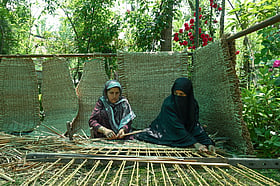
In the picturesque valley of Kashmir, a father-daughter duo is on a mission to revive a traditional craft that had almost become extinct. Ghulam Hassan and his daughter Tanzila have taken it upon themselves to bring back the Waguv, a traditional grass mat handwoven from dried rice straw and wetland reeds, which was once an integral part of Kashmiri homes.
For generations, Waguv mats were woven by artisans in Kashmir, providing a simple yet practical solution to keep homes warm during the harsh winters and cool in the summer. However, with the advent of modern flooring and synthetic mats, the demand for Waguv mats decreased, and by the early 2000s, the craft had almost disappeared. The artisans, who had passed down the tradition from generation to generation, were forced to abandon their looms and take up other work.
But Hassan and Tanzila were determined to revive the traditional craft. With the support of the Handicrafts department, they began their journey in 2020 to bring back the Waguv. Tanzila, who is pursuing a post-graduation in Persian at the University of Kashmir, took up the craft alongside her father. "I was interested in reviving the traditional Waguv as it has been part of our culture and lost its space in our homes to modernity," she said. "The Waguv, which is eco-friendly, has many advantages, not only being affordable but suited for our homes, keeping in view the harsh winter and summer heat."
The duo has been working tirelessly to promote their products, using social media platforms like Instagram, Facebook, Twitter, and WhatsApp to reach a younger generation. They have named their initiative "Kashir Waguv," and their efforts have started to pay off. The demand for Waguv mats has increased, with people approaching them directly or through social media to buy the traditional mats. Hassan and Tanzila have also trained women in the traditional skill, and now run an all-women Waguv-making unit with around 40 women, providing them with a livelihood initiative.
The craft received a significant boost when "Kashmir Waguv" was granted a Geographical Indication (GI) tag, recognizing its distinctive regional identity and traditional heritage. The certification is expected to help protect the authenticity of the craft and prevent unauthorized use of the name, ensuring consumers get access to genuine Waguv products. The effort also received national attention when Prime Minister Narendra Modi mentioned Hassan and Tanzila in his July 26 Mann Ki Baat programme, praising their dedication to preserving the traditional craft.
The resurgence of the Waguv weaving craft is not only a testament to the duo's determination but also a reflection of the Valley's rich cultural heritage. The Waguv mat is more than just a piece of furniture; it is a symbol of the region's history and traditions. As Hassan and Tanzila continue to work towards reviving the craft, they are not only preserving a part of their cultural identity but also providing a livelihood for the artisans involved in the process.
In conclusion, the story of Ghulam Hassan and Tanzila is a beacon of hope for the preservation of traditional crafts and cultural heritage. Their dedication to reviving the Waguv weaving craft is an inspiration to many, and their efforts have started to bear fruit. As the demand for Waguv mats continues to grow, it is essential to recognize the importance of preserving traditional crafts and supporting artisans who are working tirelessly to keep these traditions alive.
Summary Points
The Waguv mat is a traditional grass mat handwoven from dried rice straw and wetland reeds, which was once an integral part of Kashmiri homes.
The craft had almost disappeared by the early 2000s due to the advent of modern flooring and synthetic mats.
Ghulam Hassan and his daughter Tanzila have taken it upon themselves to revive the traditional craft, with the support of the Handicrafts department.
The duo has trained women in the traditional skill and now runs an all-women Waguv-making unit with around 40 women, providing them with a livelihood initiative.
The craft received a Geographical Indication (GI) tag, recognizing its distinctive regional identity and traditional heritage, and has received national attention from Prime Minister Narendra Modi.